Guide
9 min
Roof Waterproofing: Types, Prices & How to Choose
Complete guide to roof waterproofing — types, costs, and when you need it. Prevent roof leaks with the right waterproofing.
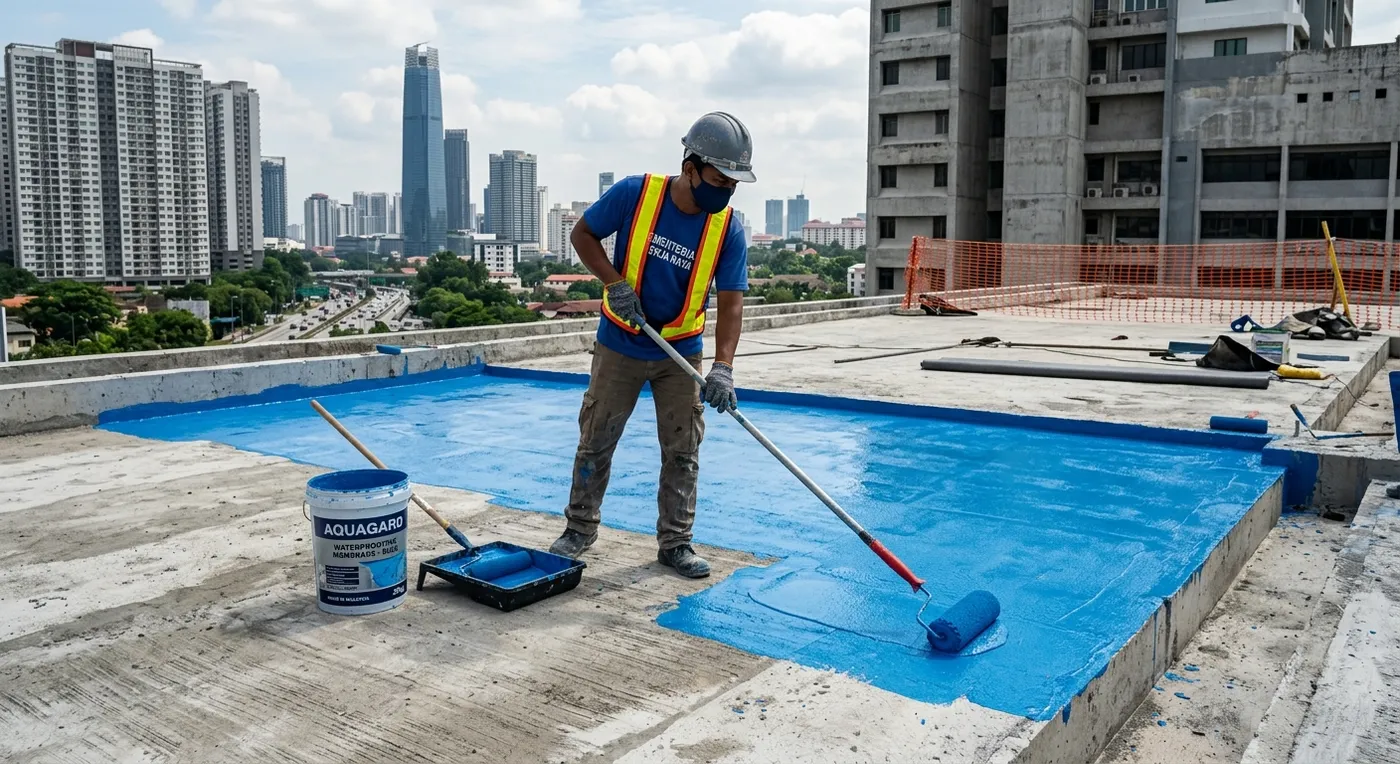
What Is Roof Waterproofing?
Roof waterproofing is the process of coating the roof surface with water-resistant materials to prevent leaks. It's essential especially for flat concrete roofs, parapets, and areas exposed to water.
Unlike a simple patch job, a waterproofing layer seals the entire surface — not just the holes you can see. That is why it is the go-to solution for concrete slab roofs, open balconies, and rooftops where water pools after rain.
Why Roofs in Malaysia Leak So Easily
Malaysian weather is punishing: scorching heat at midday, heavy rain in the evening. This constant expand-and-contract cycle creates hairline cracks in concrete surfaces over time. Rainwater seeps through those fine cracks, travels inside the slab, and eventually drips through the ceiling.
A leaking roof of this kind is hard to detect early. The drip point on the ceiling is often far from the actual source, because water travels within the structure before it exits. That is why small patches rarely solve the problem — a full waterproofing layer is needed to seal every water path.
Common causes of leaks on concrete roofs:
Hairline cracks in the slab — daily thermal expansion and contraction
Parapet joints — the wall-to-floor junction leaks most often
Blocked roof gutter — water pooling on the surface for long periods
Loose roof flashing — water entering along joint edges
An aged coating — waterproofing has a lifespan, it does not last forever
Types of Waterproofing
1. Membrane Waterproofing (Torch-On)
**Method:** Bitumen membrane is torched and adhered to the surface
**Durability:** 10 - 15 years
**Price:** RM18 - RM25 per square foot
**Best for:** Flat concrete roofs, rooftops
The toughest option for large surfaces exposed to the weather around the clock. Torch work requires real skill — make sure only an experienced roofing contractor handles it.
2. Liquid Membrane (Coating)
**Method:** Rolled or brushed onto the surface
**Durability:** 5 - 8 years
**Price:** RM12 - RM18 per square foot
**Best for:** Balconies, upper bathrooms, metal roofs
The most popular choice for homes because the work is fast and no open flame is involved. It also suits complex shapes where membrane sheets are hard to fit.
3. Cementitious Waterproofing
**Method:** A special cement mix applied to concrete surfaces
**Durability:** 8 - 12 years
**Price:** RM10 - RM15 per square foot
**Best for:** Concrete roofs, water tanks
The lowest cost of all types, but the least flexible — less suitable for structures with a lot of movement.
4. Polyurethane Waterproofing
**Method:** A flexible PU layer applied by brush or roller
**Durability:** 10 - 20 years
**Price:** RM20 - RM30 per square foot
**Best for:** High-traffic areas, roofs that need flexibility
The longest lasting and most flexible of all the options. It costs more, but it is worth it for rooftops that get walked on regularly.
Comparison Table
Type
Price/sqft
Durability
Flexibility
|-------|-----------|-----------|--------------|
Membrane
RM18-25
10-15 years
High
Liquid
RM12-18
5-8 years
Medium
Cementitious
RM10-15
8-12 years
Low
Polyurethane
RM20-30
10-20 years
Very High
When Do You Need Waterproofing?
Flat concrete roofs — waterproofing is a must from day one
After roof leak repair — as a preventive step so the problem does not return
Homes aged 10+ years — the old layer may have reached the end of its life
Before the monsoon season — protect your home from prolonged heavy rain
After renovation — make sure new joints between old and new structures are sealed
Do not wait for ceiling stains to appear. Roof leak repair starts from around RM150 for small patches, but damage to ceilings, wiring, and furniture from a neglected leak can cost far more.
Signs Your Old Waterproofing Has Failed
**Water pooling for long periods** after rain even though the surface looks fine
**Bubbling or peeling** anywhere on the coating
**Visible cracks** on the coating surface
**Damp patches on the ceiling** below a concrete roof
**A musty smell** upstairs even without visible drips
The Professional Waterproofing Process
Inspection — the contractor identifies problem areas and the true source of the leak
Surface preparation — clean, repair cracks, and dry the surface completely
Primer — apply a primer coat so the waterproofing material bonds firmly
Waterproofing — apply 2-3 coats depending on the material
Curing — leave to dry for 24-48 hours undisturbed
Water test — flood the area and monitor for 24 hours to confirm no seepage
Surface preparation is the most critical step. A coating applied over a dirty or damp surface will never bond properly — this is the main reason cheap jobs fail early.
What Affects Roof Waterproofing Prices?
Material type — from cementitious at RM10 - RM15 to polyurethane at RM20 - RM30 per square foot
Surface area — costs are calculated per square foot, so larger roofs cost more in total
Surface condition — large cracks or an old coating that needs stripping adds preparation cost
Roof access — high rooftops or tight spaces need more time and equipment
Number of coats — some materials need 2-3 coats for full protection
For context, a full roof repair for a terrace house typically runs around RM3,000 - RM8,000 depending on the scope of work — waterproofing is often part of that package.
Waterproofing vs Ordinary Roof Coating
Many homeowners confuse the two services. Roof coating or roof paint, at around RM8 per square foot, is for UV protection, heat reflection, and appearance — not a long-term leak solution. Waterproofing forms a fully sealed water-resistant layer. If your problem is a leaking roof, paint alone is not enough.
When to Call a Roofing Contractor
Roof work involves fall risks and technique that matters. Call a professional for roof waterproofing in Malaysia if:
Your roof is a flat concrete slab or a high rooftop
Leaks keep returning even after several patch attempts
The leak area is large or involves parapet joints
You are not sure of the true source of the leak
Choose a contractor who offers a written warranty. AtapPro, for example, backs waterproofing work with a warranty of up to 10 years, with 15+ years of experience and coverage across 16 states in Malaysia.
Maintenance Tips After Waterproofing
Clear the roof gutter every few months so water never pools
Avoid placing heavy or sharp objects on the waterproofing layer
Never drill or drive screws through the layer without proper sealant
Check the surface after storms or unusually heavy rain
Schedule a yearly roof inspection to catch problems early
Conclusion
Waterproofing is the best investment to protect your home from leaks. Choose the type that suits your roof structure, make sure surface preparation is done properly, and use a contractor who offers a written warranty. With simple upkeep, a waterproofing layer can protect your home for well over a decade.
Need Help From a Roofing Expert?
AtapPro is ready to help. WhatsApp us for a FREE quotation — we respond within 30 minutes.
WhatsApp AtapPro NowFAQ — Roof Waterproofing: Types, Prices & How to Choose
How long does roof waterproofing last?
It depends on the material. Liquid membrane lasts 5 - 8 years, cementitious 8 - 12 years, torch-on membrane 10 - 15 years, and polyurethane up to 20 years. Simple upkeep like clearing the roof gutter regularly helps extend the coating's lifespan.
Can waterproofing be applied while the roof is still leaking?
The source of the leak must be repaired first. Cracks are patched, the surface is cleaned and fully dried, and only then is the waterproofing layer applied. Coating a damp surface prevents proper adhesion and causes early failure.
How long does roof waterproofing work take?
It depends on the area size and material type, but plan for a few days of dry weather. After the coating is applied, it needs 24 - 48 hours of curing, followed by a 24-hour water test to confirm there is no seepage.
Do zinc or tile roofs need waterproofing?
Flat concrete roofs need full waterproofing the most. For zinc or tile roofs, leaks are usually fixed by replacing damaged sheets or repairing the roof flashing, with waterproof coating applied only to specific areas such as wall joints. A roofing contractor will recommend the right method after an inspection.